
A Welsh Prince’s Paradise: The Legend of Madoc’s Journey to Gulf Shores, Alabama in 1170 A.D
Once upon a time in the Welsh kingdom of Gwynedd, a noble prince named Madoc made a profound decision to pursue peace, love and adventure rather than the violent bloody path to become King of Wales.
Prince Madoc’s heroic choice of peace, instead of war, led him and his 500 followers to a very real twelfth-century paradise. The paradise they found in 1170, today is known as Gulf Shores, Alabama.
The Horrific Reality of 12th Century Wales
The bleak twelfth-century homeland of Prince Madoc was defined by fierce disputes and mist-shrouded mountains. Resources were scarce, life was hard and dominated by the perpetual realities of civil war.
Madoc’s father (Owain Gwyned) had managed to remain The King of Wales for more than 40 years by being shrewd, ambitious, fair, decisive and brutal when circumstances demanded it.
King Owain had 17 sons. The culture of 12th Century Wales dictated that any of these 17 Princes could legitimately lay claim to his throne upon his death. King Owain overly complicated this dangerous situation by stubbornly refusing to name his successor.
Among this large brood of seventeen, four sons stood out for their capabilities and influence: Hywell, Davydd, Madoc and Rhodri. The first two (Hywell and Davydd) were deeply rooted in ruthless power struggles that defined Welsh monarch succession.
Hywell, initially took the throne after King Owain’s death and was quickly murdered by his half-brother Davydd. Chaos ensued and powerful clans began carving up the kingdom in a violent civil war. The nature of this royal struggle was vicious, driven by ambition and a grim sense of survival.
Fortunately for Prince Madoc and his bother Prince Rhodri, they had foreseen the grim reality of what would happen after King Owain’s passing and had taken highly designed and calculated actions to avoid their impending doom.
Madoc: Commander and Confidant of the Vikings
Prince Madoc was a man of a different temperament. He possessed a deeply compassionate nature that recoiled from treachery and bloodshed. Furthermore, unlike his land-focused brothers, Madoc’s life was defined by the sea. He was an experienced and talented sailor, a seasoned navigator, and held the position of Commander in the Welsh navy.
Prince Madoc’s skills were not limited to coastal defense. He was an adventurer, trader and fisherman who had cultivated a unique relationship with the era’s preeminent seafarers…the Vikings. Madoc was a trusted ally, trading partner and confidant of the Norsemen. Through his extensive interactions over a long period of time, he became privy to their closely guarded lore.
The Vikings, who had already established settlements in North America centuries earlier, spoke of vast lands that were South and West of the territories the Norseman had already colonized. The bold stories told of sparsely populated geographic areas with abundant food, fresh water and resources. To a Welshman familiar with scarcity and struggles, the concept of such a peaceful sanctuary sounded like a dream.
The Decision to Seek Paradise
When Prince Madoc and his brother Prince Rhodri (born of the same mother) witnessed a decline in their father’s health and vigor in 1164, they conspired a lofty and ambitious plan. The next year they put their plan into action.
In 1165 Prince Madoc convinced his highly trusted Norseman ally to become the working navigator on a new and radical Viking expedition. This voyage departed on an exploratory journey to the northern coastline of a body of water today known as the Gulf of America. While on this voyage they encountered Moblie Bay and at that moment Madoc knew this specific location would be his destination when all hell broke loose in his homeland.
Upon Madoc’s return to Wales, he and his brother finalized their extensive plot of exodus. These plans remained a secret until their father’s passing in 1169. This detailed proposal recognized the merciless natures of their sibling brothers and contained a promise (sacred pact) to self exile themselves along with their most trusted followers in exchange for a peaceful no conflict departure that benefited all parties.
This pact was unanimously agreed upon by their fifteen throne seeking brothers and it granted a solid guarantee that Madoc and his brother Rhondri would have the means and the time to successfully depart Wales shortly after King Owain’s death.
The First Voyage and the Discovery of Navy Cove
The plan called for an initial expedition of a modest fleet of three ships and a crew of 100. Their mission was to establish a sustainable beach head for another 400 family members and friends to follow.
Shortly after King Owain’s death in the fall of 1169, Prince Madoc sailed west across the Atlantic to find paradise. His departure was in February of 1170. Madoc relied heavely on his naval commander skills along with Viking navigational devices.
In March of 1170 Prince Madoc’s 3 ships and crew of 100 arrived at their destination… the entrance to a vast sheltered body of water… Mobile Bay. His initial landing point was at the western end of a peninsula on the eastern side of the bay’s mouth. This location is known as Fort Morgan today. Specifically, he anchored his small fleet in a quiet protected inlet called Navy Cove.
Today all residences and businesses of Navy Cove and on the Fort Morgan Peninsula have a United States Postal Service address and zip code of Gulf Shores, Alabama 36542.
This bay was a veritable paradise… just as Prince Madoc remembered as the navigator for the Norseman. The waters teemed with fish and there was an abundance of easily harvested oysters. The lush surrounding forests were full of wild game and crucially, there was an abundance of fresh spring water, firewood and shelter materials. It was a peaceful haven and a stark contrast to the blood-soaked hills of Wales.
Peaceful Integration and a Lingering Mystery
According to the enduring legend, Madoc and his followers did not arrive as conquerors. They came in peace, seeking only a place to live in harmony. They successfully integrated with the sparse and peaceful indigenous peoples living in the area, engaged in trade and crucially intermarried.
The Welsh explorers were said to have ventured far inland, exploring the vast network of rivers that flow into Mobile Bay and over centuries explored the Mississippi River territories.
Some historians and enthusiasts claim these Welsh explorers left evidence of their presence in multiple locations, sighting reported encounters with Welsh speaking Native American tribes, Welsh style boats and Welsh style fortifications all the way up to the Ohio River Valley.
The ultimate fate of Madoc and his colony remains one of North America’s great historical mysteries. Their assimilation into the local Native American cultures and the fading of their Welsh identity over generation makes it difficult to prove they landed in America in 1170, however there is some compelling evidence that the legend is true.
The story speaks to a universal human desire for peace, the allure of a new beginning, and the courage of a navigator who chose paradise over a blood soaked throne in Wales. The shores of Mobile Bay, with its quiet coves and rich history, still whisper the possibility that a Welsh prince found a haven in Gulf Shores, Alabama in the year 1170.
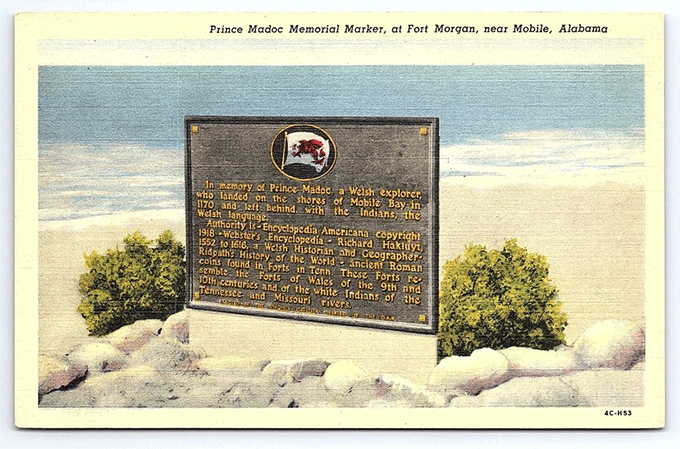
The image above is a vintage postcard of The Daughters of The American Revolution’s plaque regarding Prince Madoc. This historic plaque was erected in 1953 at Fort Morgan State Park to commemorate the landing of the Welsh Prince Madoc at this location in 1170.
The plaque declares, “In memory of Prince Madoc, a Welsh explorer who landed on the shores of Mobile in 1170 and left behind, with the Indians, the knowledge of the Welsh language”.
This plaque was knocked down by hurricane Frederic in 1979. It currently is in storage and no longer on public display at its original location.
.
The Return and the Second Expedition
Madoc and his crew of 100 established a temporary settlement, affirming the viability of their new found home paradise. In late October of 1170, Madoc made the journey back to Wales.
Taking 2 of the 3 ship fleet, he set sail with a crew of 32. He successfully made the voyage back to his homeland and was pleased to discover that his brother Prince Rhodri and their 400 family and friends were safe. All were there to greet him and were ecstatic that he had returned.
While Prince Madoc had been gone, Rhodri had time to secure all the necessary equipment and supplies needed for the 12 ship fleet that would be making the adventurous voyage to the new promised land. All of the passengers and crew were ready to go and quickly loaded up to set out on their adventurous voyage.
The fleet of 12 ships (10 new plus Madoc’s original 2) was capable of transporting 400 passengers and provisions. In December of 1170 this gallant fleet set sail without incident from the warring madness that had engulfed their homeland.
A few weeks later under the command of Prince Madoc, the fleet made landfall on the sandy shores of their new found paradise…Gulf Shores, Alabama.

The Video below is from the YouTube Channel “The Why Files”. This segment of an episode called “The Mooned Eyed People” tells of Prince Madoc’s 1170 expedition, evidence of Prince Madoc’s establishment of Welsh settlements and their intermingling with Native American tribes. The “Why Files” YouTube Channel has over 5.6 million subscribers and this video has over 2.7 million views.